
A friend of mine just bought an '88 Ski Supreme competition ski boat and cliams that there are "bubbles" coming out of the gel coat on the hull. Does anyone have an idea as to what these are, what might be causing them, and how to fix the problem?





-
-
Probably air bubbles. It could have been from the boat sitting in the water for long periods of time. You have to sand them down and do some gelcoat work on them. -
Skinautique,
What do you mean "some gel coat work"? Can I use a polishing substance and grind the bubbles down, or are you refering to something else?Comment
-
go to the interlux web site and look up blistering or osmosis.red right returnComment
-
Blister Repair
by Don Casey
Fiberglass blisters occur because water passes through the gelcoat. Water soluble chemicals inside the laminate exert an osmotic pull on water outside, and some water molecules find a way through the gelcoat. As more water is attracted into the enclosed space, internal pressure builds. The water molecules aren't squirted back out the way they came in because they have combined with the attracting chemicals into a solution with a larger molecular structure. Instead, the pressure pushes the covering gelcoat into a dome-a blister.
There has been a great deal of hysteria about blisters, but the reality is that the number of boats that develop serious blister problems is extremely small. An occasional blister or two is not a serious problem, any more than is an occasional gouge in the hull. Some boats seem to exhibit a greater propensity to blister, presumably due to the chemical components used and/or the layup schedule, but all boats are at some risk. Surveys suggest that about one boat in four develops blisters.
Repair materials
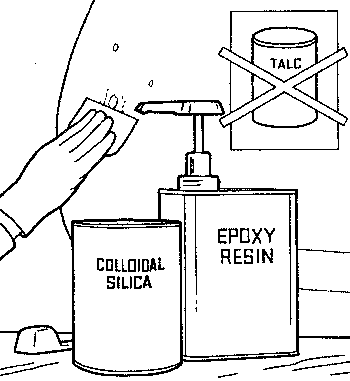
Effecting the repair of a few hull blisters requires an appropriate quantity of epoxy resin and hardener. Do not use polyester resin for blister repairs; you need the stronger adhesion and better water impermeability epoxy provides.
You also need a filler to thicken the epoxy into a putty. Select colloidal silica. Never use microballoons or any other hollow or absorbent (talc, for example) fairing compound to fill blisters.
A quart of acetone, a box of TSP (trisodium phosphate), a few acid brushes, and a 36-grit sanding disk completes your supply list. If the blisters penetrate the laminate, you may also need a yard of 6 to 10 ounce fiberglass cloth.
Minor Blistering
The first step in minor-blister repair is opening the blister to let it drain. Pop the dome with a chisel, screwdriver, or rotary tool. Be sure you are wearing eye protection; pressure inside a hull blister can be double that of a bottle of champagne, and the fluid that blasts out when you pop it is acid
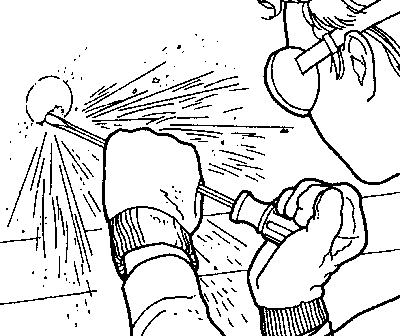
Load a disk grinder with your 36-grit disk and grind the open blister into a shallow depression. The rule of thumb is that the depression should be 20 times as wide as it is deep, and it should only be as deep as required to remove any damaged laminate beneath the gelcoat.
Use a plastic mallet or the handle of a screwdriver to tap the hull all around the blister. Sound laminate will give a sharp report. A dull or flat sound anywhere indicates additional delamination, meaning that the blister is larger than you thought. Increase the circumference (not the depth) of the depression until the laminate all around it is sound.
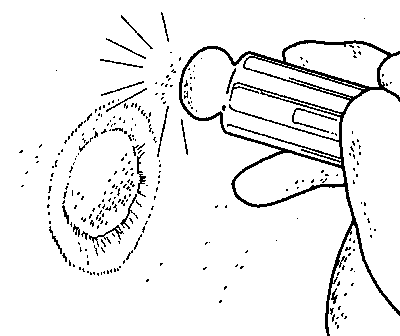
Flush the open blister with water, then scrub it squeaky clean with a solution of hot water (if available) and TSP-about a quarter cup of TSP to a gallon of water. Rinse thoroughly, then allow the blister to dry for at least 48 hours, longer if practical. If you dry-store your boat for the winter, grind and scrub blisters at haulout but don't fill them until launch time.
Filling
Just before filling, scrub each depression briskly with a clean rag dampened with acetone.
Mix a small quantity of epoxy (one pump) and paint this unthickened resin into the cavity. Wet out the entire surface of the depression. Use an acid brush to apply the epoxy and give this application 20 or 30 minutes to begin to kick. For shallow blisters, prepare a small amount of fresh epoxy (one or two pumps) and thicken it to peanut butter consistency with colloidal silica. Fill the depression completely with this mix, using a squeegee to compress and fair the filler. Silica-thickened epoxy is difficult to sand, so take extra time to fair the epoxy as well as possible while it is wet.
Deep blisters require the replacement of the damaged glass fabric. Cut a disk of fiberglass cloth the size of the bottom of the depression, then cut several more, each a little larger than the last. Use only cloth; never use fiberglass mat with epoxy resin.
Wet the bottom of the cavity with epoxy and lay in the smallest disk of cloth. Wet out the cloth with resin until it is transparent, then lay in the next, slightly larger disk. Wet this one out, using the end of the brush to tamp the disks and compress them together. Continue adding disks and saturating them with resin until the repair is even with the surrounding surface.
Whether you have filled the cavity with glass disks or epoxy putty, allow the filler to kick. When the epoxy is no longer fluid, but still tacky, paint the repair and an inch or so beyond with at least two coats of unthickened epoxy, letting each coat kick before applying the next.
Let the repair cure for 24 hours, then scrub it with water and an abrasive pad (like Scotchbrite) to remove the waxy film on the surface of the epoxy. Fair the repair with a sanding block and you are finished.
Gelcoat should never be applied over epoxy. Since the repair will be covered with bottom paint, there is no need for a gelcoat surface anyway. Don't use gelcoat in blister repair.
Boat Pox
Boat pox is a much more serious condition, related to the occasional blister like acne to the occasional pimple. If the bottom of your boat is covered with blisters, filling them won't cure the problem. Pox is a systemic condition indicating that the hull is saturated. The actions necessary to remedy boat pox require specialized equipment and expertise.Please do not PM me directly asking for advice on how to repair your boat. While I would love to help everyone, I simply do not have time to respond to all of the inquiries. Please post your questions on the forum, so that all of our members have a chance to answer.
I own and operate Silver Cove Marine, which is an inboard boat restoration, service, and sales facility located in Mooresville, North Carolina.
We specialize in Nautique and Correct Craft restorations, and also provide general service for Nautiques fifteen years old and older.
If we can be of service to you, please contact us anytime!

Current Boats —> 2026 Super Air Nautique G23 -- 2000 Nautique Super Sport PYTHON -- 1985 Sea Nautique 2700 (Twin-Engine, 1 of 13) -- 1981 Fish Nautique (Twin-Engine, 1 of 4) -- 1980 Fish Nautique (Twin-Engine, 1 of 4) -- 1978 Cuddy Nautique
Former Boats —> 2025 Super Air Nautique G23 -- 2024 Super Air Nautique G23 PARAGON -- 2023 Super Air Nautique G23 -- 2022 Super Air Nautique G23 PARAGON -- 2021 Super Air Nautique G23 -- 2021 Super Air Nautique G23 -- 2020 Super Air Nautique G23 -- 2019 Super Air Nautique G23 -- 2018 Super Air Nautique G23-- 2018 SAN 210 TE -- 2017 Super Air Nautique G23 -- 2016 Super Air Nautique G23 -- 2015 Super Air Nautique G23 -- 2014 Super Air Nautique G23 -- 2014 Super Air Nautique 230 Team Edition — 2013 Super Air Nautique G23 — 2012 Super Air Nautique 210 Team Edition — 2011 Super Air Nautique 210 Team Edition — 2010 Super Air Nautique 210 Team Edition — 2008 Super Air Nautique 230 Team Edition — 2007 Air Nautique 236 Team Edition -- 2007 Air Nautique SV-211 -- 2005 SV-211 -- 2003 Super Air Nautique 210 Team Edition -- 2003 Air Nautique 226 -- 2003 Sport Nautique 216 -- 2003 Ski Nautique 196 -- 2003 Ski Nautique 196-- 2002 Ski Nautique -- 2001 Sport Nautique -- 2001 Ski Nautique -- 2001 Ski Nautique -- 2000 Sport Nautique -- 2000 Nautique Super Sport -- 1999 Ski Nautique PYTHON -- 1999 Ski Nautique Open Bow -- 1999 Air Tique 176 -- 1998 Ski Nautique -- 1998 Ski Nautique -- 1998 Ski Nautique -- 1997 Ski Nautique -- 1997 Ski Nautique -- 1996 Ski Nautique Open Bow -- 1994 Ski Nautique -- 1993 Barefoot Nautique -- 1983 Fish Nautique (TWIN ENGINE, 1 of 4) -- 1981 Fish Nautique (SINGLE ENGINE)
Need something for your boat? Please check out our site sponsors! Not only do they offer the best products available, they also support this site.
Silver Cove Marine - NautiqueParts.com - Phoenix Trailers - SkiSafe - PCM Marine Engines - C&S Marine - OJ PropellersComment
-
i have it to on my 89 ski nautique, i think there are 22 of them and some of them are cracked open. :|
i did it today like nautiquejeff says, but i still have to fill it with expoxy. Now its drying i did it today but i think i have to go bigger wiht sanding i gonna post some pic tommorow
Comment
-
I bought a 206 in March. Due to logistics and accessability, the boat sits in the water at the lake. I will pull it out once a month to clean. When I cleaned it this weekend, I noticed small bubbles or blisters on the hull. They were in two areas. This concerns me, especially since the boat is 6 months old. I was told by the dealer that it was o.k. to leave the boat in the water. Am I screwing my boat by leaving it in the water? Do I need to fix the blisters/bubbles now? Do I need to wax it more often? Do I need to call the dealer? Any thoughts would be appreciatedComment
-
back to the dealer it should go.. the sooner the better, imo.
cdmComment
-
I would at least make sure your dealer make a note in your file about your concern and notify correct craft also.Comment
-
That is not normal. You should have it repaired sooner than later.Comment
-
I would consider taking a tip from the Great Lakes boaters, they leave their boats in the water, but the boats are all bottom painted if they are left floating.
I lived in Pittsburgh when I bought my '95 Ski Nautique. I found my boat in Ohio because many used boats I saw in the 'Burgh (there were only a few) all had gel coat blisters because alot of people left their boats floating in the river. When I was boat shopping, a fiberglass shop explained all of the work required to fix the blisters and concluded the discussion by saying I should just buy a different boat.
Hopefully you can find another option, I personally would not buy a bottom painted Nautique and I don't think many people would, but if you plan to keep it 20 years and you have to leave it in the water that is better than ruining your fiberglass. I am not an expert and I don't think bottom painting is great way to go but it points out how the boat needs to be protected from the water.Comment


Comment